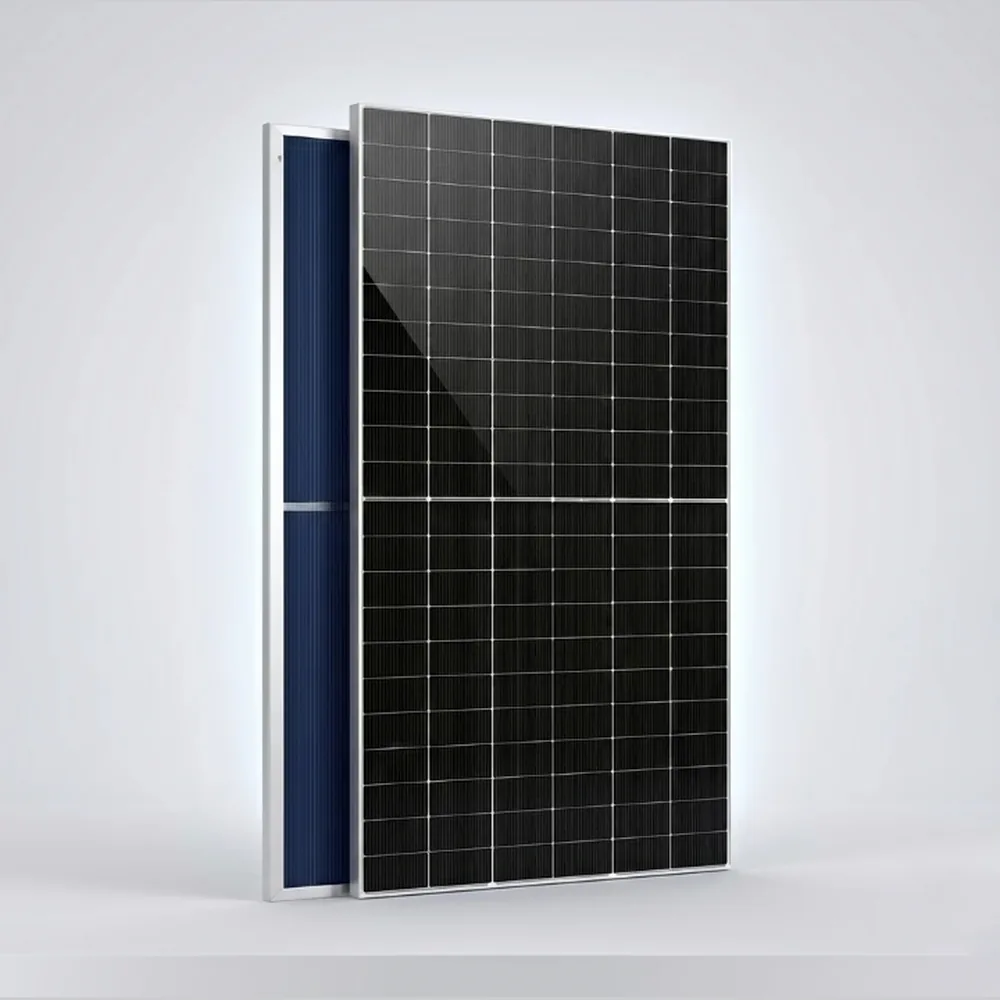
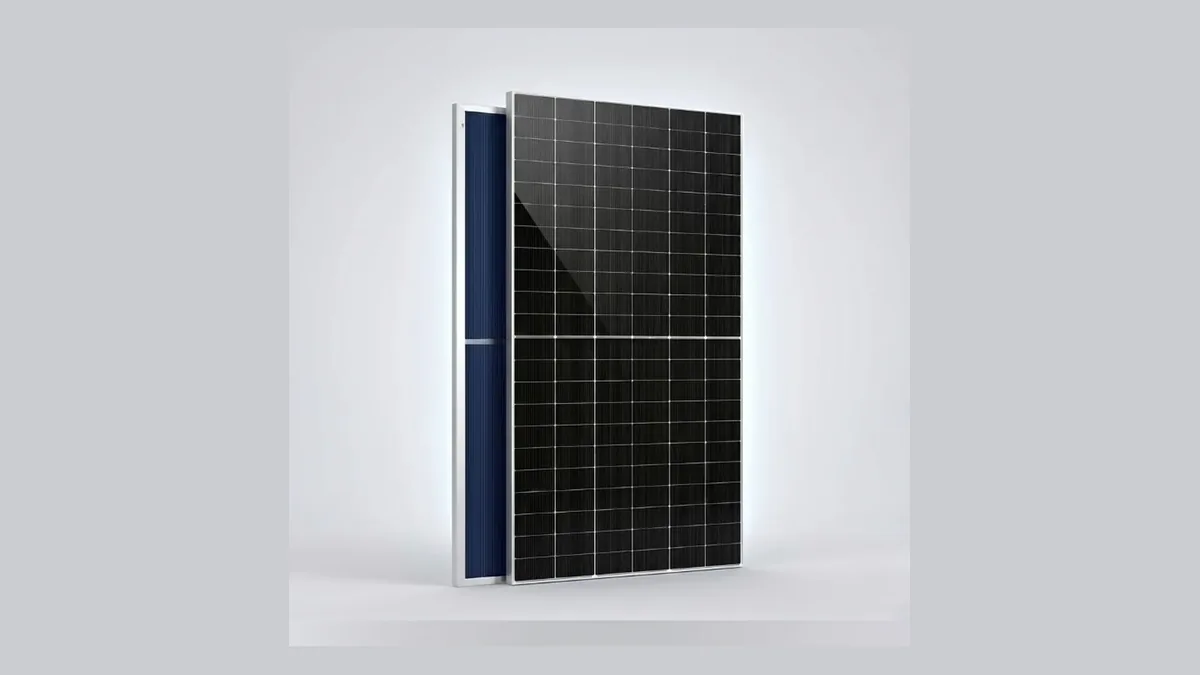
Choosing a solar module starts with two numbers, not a brand name: the energy you need in kilowatt-hours, and the unshaded area you can use. Once those are fixed, monocrystalline half-cut modules are the rational default for almost every roof, and polycrystalline makes sense only where surface area is cheap and abundant.
Size the array before you pick the module
Array size in kilowatts equals daily demand divided by peak sun hours (PSH) times a loss factor of 0.75 to 0.85, which covers temperature, soiling, cabling, inverter conversion and module mismatch together.
A 10 kWh daily load at 5 PSH and a 0.8 loss factor gives a denominator of 4 and an array of about 2.5 kW — roughly five modules in the 550 W class. Run it on your own load with the solar system sizing calculator. Area is a second constraint: modern mono modules need roughly 4 to 5 square metres per kilowatt.
Mono, poly and bifacial as a purchase decision
Monocrystalline is cut from a single-crystal ingot; commercial module efficiency typically sits around 19 to 23 percent, the highest output per square metre — see the monocrystalline panel category. Polycrystalline is cast silicon: lower efficiency and more area for the same output, with a niche on open ground where cost per watt outranks area.
Bifacial modules replace the opaque backsheet with glass and convert light reflected off the surface below; the gain depends on ground albedo and mounting height, so it is a mounting decision. Half-cut construction halves cell current, and resistive loss scales with the square of current, so internal losses drop; the module is also wired as two parallel halves, so shade on the lower row does not stop the upper half producing.
Why nameplate watts is a poor comparison
The label figure is measured at Standard Test Conditions: 1000 W/m² and 25 °C cell temperature, which your roof never sees in summer. Annual kilowatt-hours pay you back, not installed watts.
- Temperature coefficient of Pmax — commonly around -0.29 to -0.35 %/°C on current mono modules. Cell temperature easily reaches 60 °C, so a coefficient closer to zero means real summer output.
- Watts per square metre — two 550 W modules can differ in size, so on a constrained roof compare area-normalised output, including inter-row spacing.
Reading the datasheet
Ask for the datasheet of the exact model and read Pmax, Voc and Isc; the temperature coefficients; NOCT or NMOT; module efficiency (not cell efficiency); maximum system voltage; and mechanical load.
Mechanical load is given in pascals as downward pressure (snow) and uplift (wind). In snow-loaded regions the pressure rating on a low-pitch roof becomes the limiting specification, and it holds only with the mounting method approved in that datasheet — moving the clamps invalidates it; see the pitched-roof mounting guide. Connectors matter too: mating "MC4-like" parts from two manufacturers is a common origin of DC fires.
Warranty structure: product versus performance
The product warranty covers defects in materials and workmanship — delamination, junction box failure, frame corrosion. The performance warranty guarantees output in year n stays above a stated percentage of nameplate, normally a first-year allowance then a fixed annual slope. Ask for both periods and who honours the claim in your market; see the warranty page.
Decision matrix
| Situation | Choose | Why |
|---|---|---|
| Small roof, high consumption | High-efficiency mono | Least area per kilowatt |
| Open ground, cost per watt leads | Standard mono or poly | Area is not the constraint |
| Hot climate, long summer | Pmax coefficient closest to zero | Less derating when cells run hot |
| Cold, snow-loaded climate | High pressure-load rating, strong frame | Snow and wind load the frame |
| Grid-tied system | Identical modules, Voc inside the MPPT window | Less mismatch loss |
| Off-grid with batteries | Mono, sized for charging overhead | Undersized array means partial charge |
| Raised structure, bright surface | Bifacial | Rear-side gain |
Common buying mistakes
- Comparing on watts and cost per watt alone.
- Mixing module models in one series string — it follows its weakest member.
- Ignoring the cold-temperature Voc rise; calculate with the site minimum temperature.
- Underestimating partial shade, or buying without a traceable serial number.
For a shortlist matched to your site, use the request for quotation form.
Frequently asked questions
Which is better, monocrystalline or polycrystalline?
Monocrystalline is the rational default for almost all rooftop and commercial installations, because it delivers more watts per square metre. Polycrystalline is justified only where surface area is abundant and cost per watt is the deciding criterion.
How much energy does a 550 W solar module produce?
At about 5 peak sun hours and a 0.8 loss factor, a 550 W module yields roughly 2.2 kWh per day and around 800 kWh over a year. That is an annual average: summer output is higher and winter lower, and irradiance, tilt, shading and cleanliness all move the figure.
What should I check on the datasheet before buying?
Read module efficiency, the Pmax temperature coefficient, dimensions and weight, maximum system voltage and the mechanical load rating for the exact model. Then ask for the product and performance warranty periods separately, because they are different commitments.
Related products
All Solar Panels