
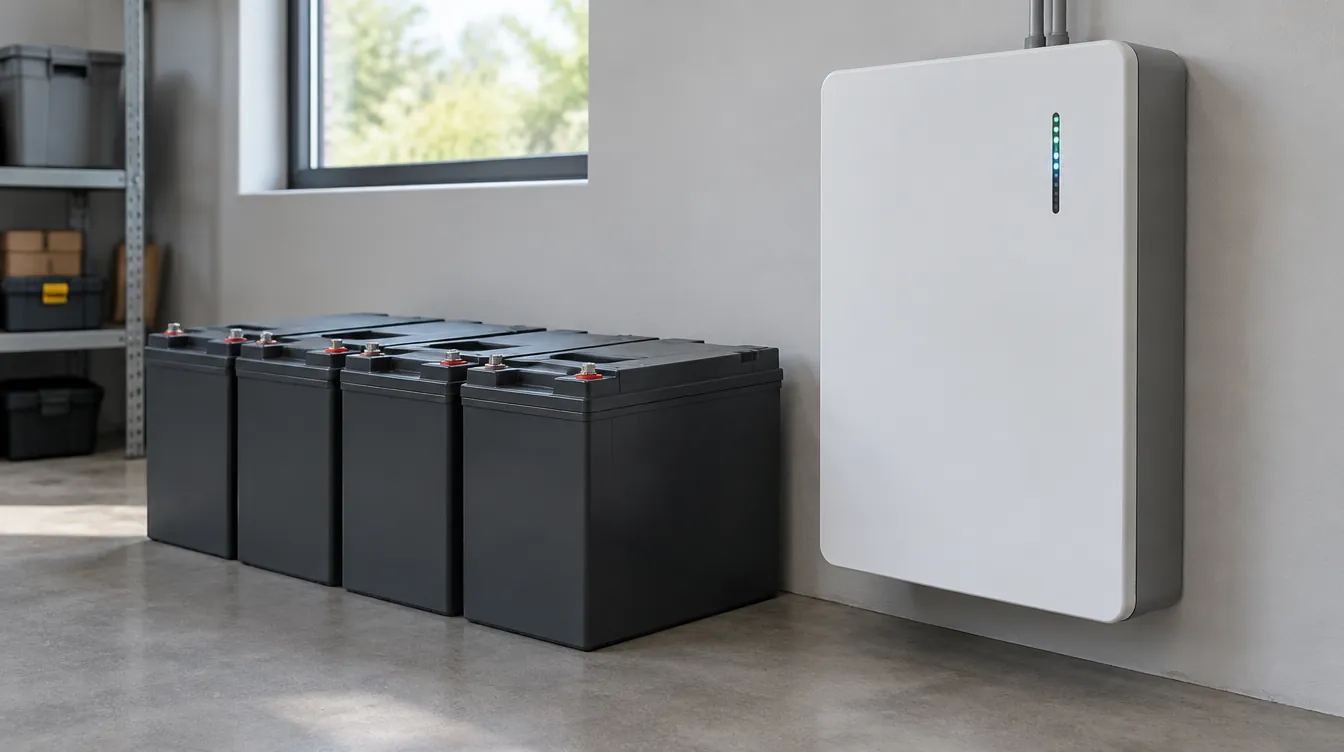
You have chosen the inverter and panels, but on the battery you hear two answers: "lead-acid is proven and cheaper" and "go lithium". Both are right from their own angle. Whether lithium or lead-acid is the better battery for solar depends on how deeply the battery cycles each day, where it is installed, which inverter sits next to it and your upfront budget.
Lithium vs lead-acid battery for solar: start with the battery's role
A battery either stays full on standby, discharging only during occasional outages as in a UPS, or works every day: charged by panels by day and supplying the home at night. The second is cyclic duty.
The more cyclic and deeper the use, the stronger lithium's case; on standby, a suitable lead-acid battery is still sensible. Undecided between backup and solar? See our home backup power guide.
The lead-acid family: sealed AGM, gel, tubular and deep-cycle
"Acid battery" covers several look-alike types built for different jobs.
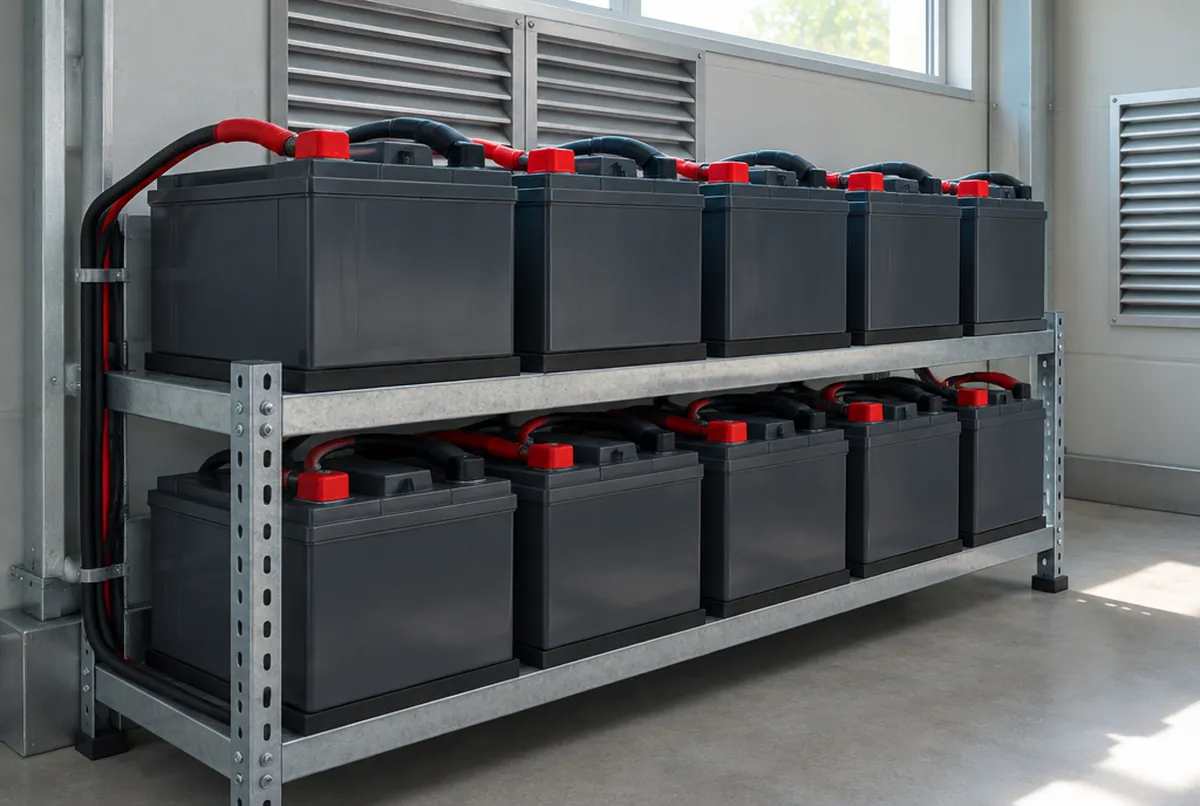
- Sealed AGM: sealed (VRLA) batteries need no water topping; the electrolyte is absorbed in a glass-fibre separator. Small UPS batteries such as the High Rate series are built for standby and short high-current discharges, not nightly cycling.
- Gel: usually needs a gel charge profile. Medal Power 12 V gel batteries at 100, 150 and 200 Ah are listed in their specs as AGM-GEL deep-cycle.
- Deep-cycle: built for repeated deep discharge, not just float. Power Solid PS-12400-DCR and PS-122000-DCR are sealed deep-cycle examples. Using UPS batteries for daily cycling is a common cause of early failure.
- Tubular: a tubular positive plate resists repeated cycling. Many are flooded and need water checks. They are heavy; the ThreeWatt 12 V tubular battery WT-1259K-T3 lists 59 kg and is presented for daily deep discharge.
See the whole family in the sealed lead-acid and gel batteries category.
What is a lithium solar battery, and why LiFePO4?
Solar lithium is usually LiFePO4, valued for thermal stability and daily cycling. Cells are about 3.2 V, so "12 V" batteries read 12.8 V and 48 V banks 51.2 V.
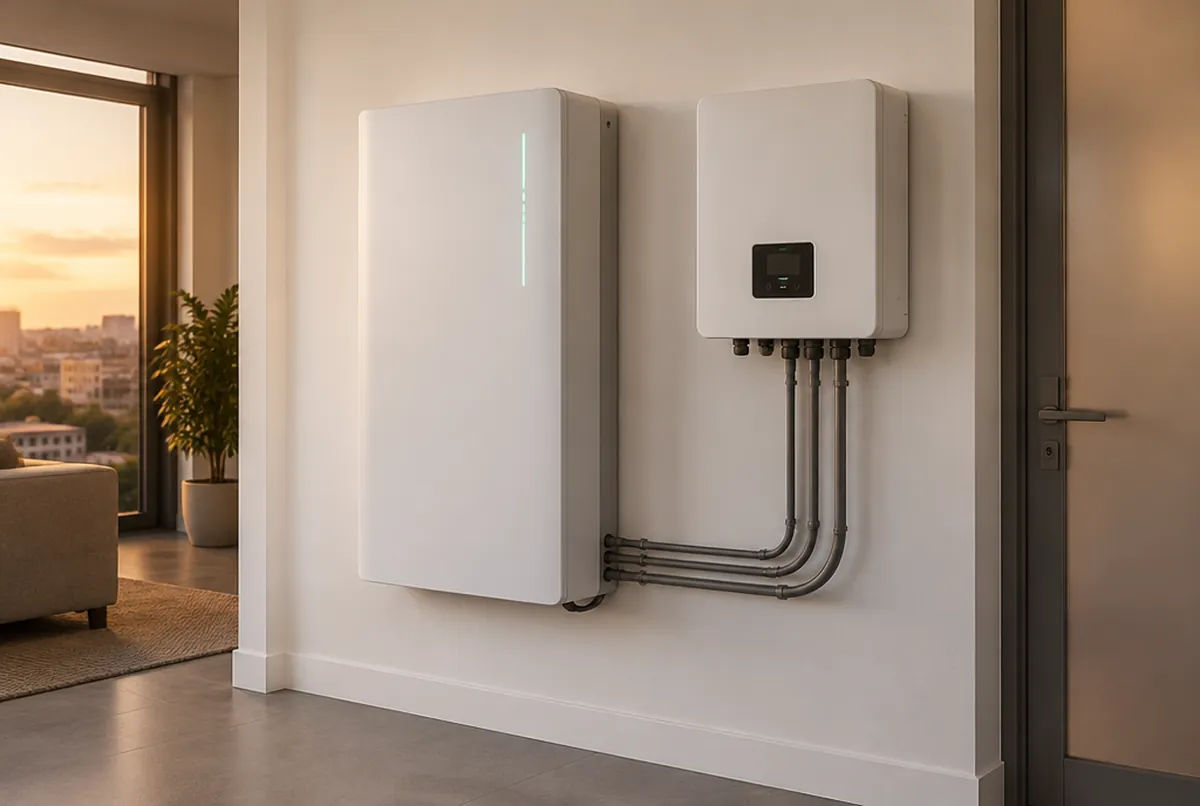
A built-in BMS monitors voltage, current and temperature and cuts off when unsafe; larger units can report to a compatible hybrid inverter.
- Advantages: usually more usable capacity, lighter and smaller for the same energy, flatter voltage, less upkeep.
- Limitations: higher upfront cost; needs a lithium charge profile; charging below 0 °C is usually not allowed, so install indoors in cold areas.
For example, the GoGo Power 51.2 V 100 Ah wall-mounted lithium battery has 51.2 × 100 = 5,120 Wh, or 5.12 kWh, of nominal energy. Browse the lithium batteries category.
Comparison at a glance and usable energy
A qualitative comparison; check each datasheet.
| Criterion | Lithium (LiFePO4) | Lead-acid (sealed, gel, tubular) |
|---|---|---|
| Usable depth of discharge | Usually higher | Usually lower; frequent deep discharge shortens life |
| Weight and size for equal energy | Lower | Higher, especially tubular |
| Maintenance and ventilation | Low; needs a cool, dry place | Low for sealed/gel; flooded needs water; ventilate |
| Voltage during discharge | Flatter | Drops gradually |
| Upfront cost | Higher | Lower |
| Compatibility needs | Higher; lithium profile and BMS link in hybrids | Lower; most chargers have a lead-acid profile |
| Cold weather | Charging below 0 °C usually not allowed | Capacity drops; do not leave flat in freezing conditions |
Usable energy depends on depth of discharge (see what battery DoD is). Hypothetical example: 2 kWh overnight at 24 V, assuming half of a lead-acid bank and four-fifths of a lithium bank are usable (assumptions, not specs). Lead-acid: 2 ÷ 0.5 = 4 kWh nominal, about 4000 ÷ 24 ≈ 167 Ah. Lithium: 2 ÷ 0.8 = 2.5 kWh nominal, about 2500 ÷ 24 ≈ 104 Ah. Add margin for losses and cloudy days.
12, 24 or 48 V and matching the inverter
The bank's nominal voltage must match the inverter's battery voltage (12.8 V lithium pairs with 12 V, 51.2 V with 48 V). Smaller inverters are usually 12 or 24 V; larger systems favour 48 V because the same power needs less current and thinner cable; many home hybrid inverters use 48 V, but check datasheets. See on-grid, off-grid or hybrid inverter.
- Never mix chemistries, models or ages in one bank.
- Wiring, fuses and charge settings only by a qualified installer.
Which battery suits you?
Choose lead-acid for standby use, a tight upfront budget, an inverter without a lithium profile, or a cold location you cannot keep warm. Choose lithium for nightly solar cycling, a hybrid inverter with BMS link, tight space such as an apartment wall, or later modular expansion. Before buying, know your kWh use and inverter battery voltage.
Send your inverter model and use via the quote request form. Noora Tajdid Paziran supplies with an authenticity guarantee and official warranty, offers installer and wholesale pricing, and ships from Tabriz.
Frequently asked questions
Is lithium or lead-acid better?
Neither for everyone: lithium usually suits daily cycling; deep-cycle lead-acid suits standby and tight budgets.
Can I replace my lead-acid battery with lithium?
By voltage, a 12.8 V lithium battery can stand in for a 12 V lead-acid one, but the charger or inverter needs a lithium profile and the current drawn must stay within the BMS limit. Leave this to an installer and do not mix old and new batteries in one bank.
What is a tubular battery for?
A heavy lead-acid type with a tubular positive plate for repeated deep discharge, common in off-grid banks.
Do lithium batteries have problems in cold climates?
Discharge in the cold is usually possible with less capacity, but charging LiFePO4 below 0 °C is usually not allowed, and only a BMS with low-temperature protection will block it. Install the battery indoors, away from direct cold.