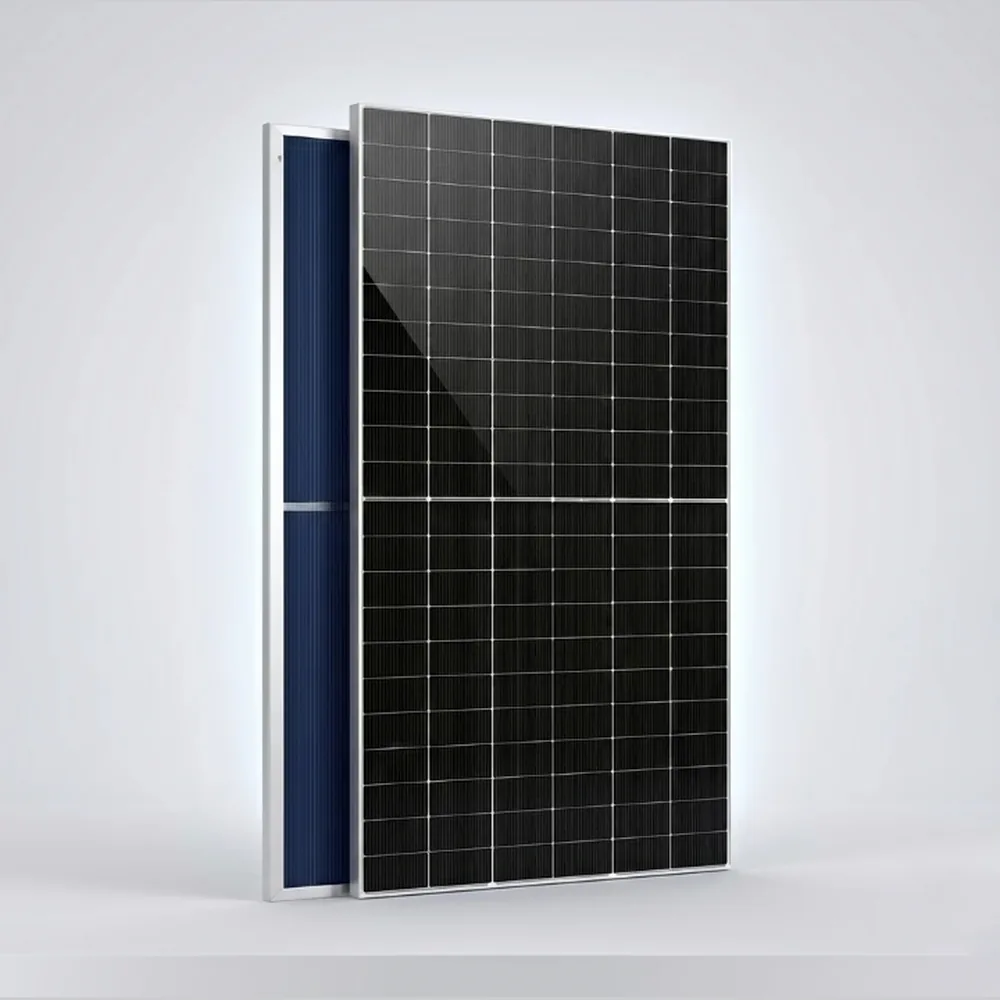
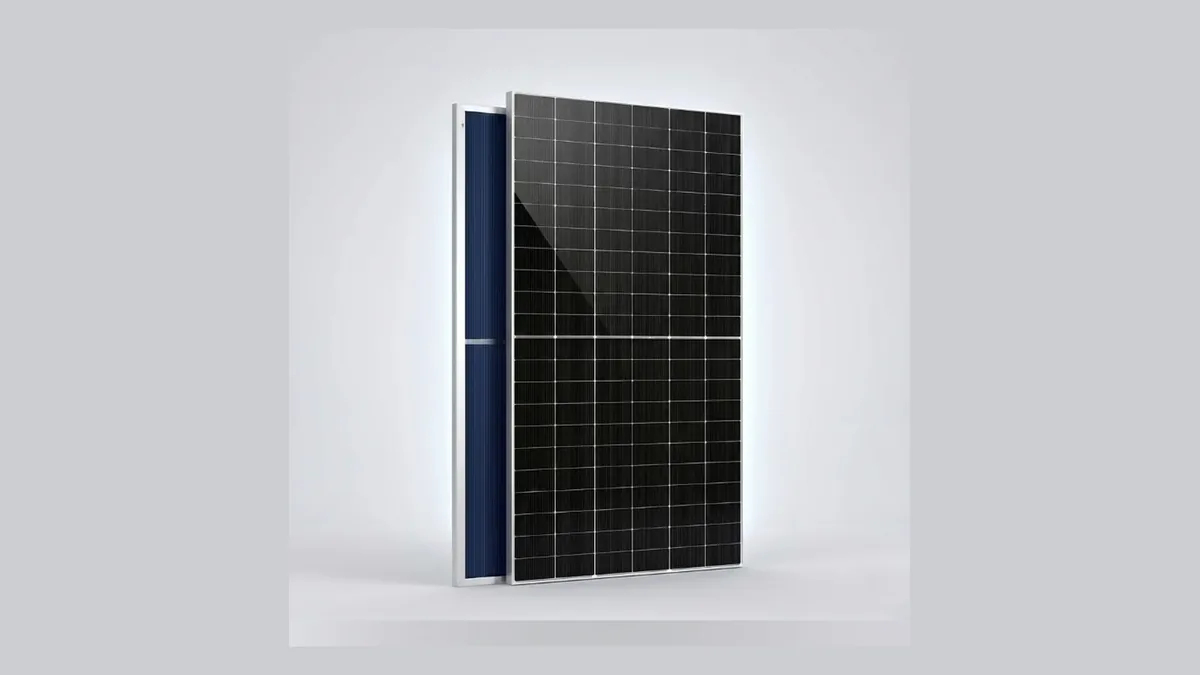
A monocrystalline panel uses cells cut from a single continuous silicon crystal. The uniform lattice gives electrons a less obstructed path, so the module delivers more watts per square metre. Almost every high-power module today, including the 550W class, is monocrystalline.
How mono cells are made, and how poly differs
A seed crystal is dipped into molten silicon and drawn out slowly while rotating, giving a cylindrical single-crystal ingot sliced into wafers; because the ingot is round, each wafer has chamfered corners — the visual signature of mono. Polycrystalline silicon is cast in a square crucible and cooled, forming many grains whose boundaries impede electron movement, hence the flaked blue pattern and lower efficiency.
Reading efficiency figures correctly
Module efficiency is nameplate power divided by module area times 1000 W/m². Commercial mono modules sit at roughly 19-23%, poly at 15-18%; cell efficiency is always higher, since frame and cell gaps count as area but generate nothing. Efficiency buys watts per square metre — decisive when roof area is the constraint. Estimate what you need with the solar system sizing calculator.
PERC, half-cut and bifacial: what each actually changes
PERC adds a passivation layer and a rear reflector, giving light that already crossed the cell a second chance at absorption and cutting rear-surface recombination. It improves long-wavelength and low-light response and is now standard on most mono modules; newer n-type architectures such as TOPCon and heterojunction offer better temperature coefficients.
Half-cut modules split each cell in two. Per-cell current halves, and since resistive loss scales with the square of current, those losses drop sharply. The module behaves as two parallel halves, so a horizontal shadow across the bottom row does not disable it.
Bifacial modules also collect reflected light on the rear face, but the gain depends on installation: meaningful over a bright surface with elevated mounting, close to nothing on a dark roof mounted flush. They are heavier glass-glass units needing different mounting.
Temperature coefficient matters more than nameplate watts
Nameplate power is measured at 25°C cell temperature, which a hot-climate rooftop never sees; cells reach 60-70°C at midday in summer. The Pmax coefficient on mono PERC is typically 0.30-0.40% loss per °C, so a 40°C rise costs roughly 12-16% of output. Two 550W modules with coefficients of 0.29 and 0.38 differ by several percent every sunny midday.
NOCT (or NMOT) is the related figure: cell temperature at 800 W/m², 20°C ambient and light wind, commonly 41-45°C — lower runs cooler. Keep an air gap beneath the modules, since flush mounting raises it.
Degradation and how warranties are structured
Every module loses power over its life: some in the first hours of light exposure, the rest as gradual annual decline, typically under 1% a year. Warranties come in two separate parts, and the structure is what matters:
- Product warranty — covers manufacturing defects and workmanship for a stated term.
- Performance warranty — output stays above a stated percentage of nameplate in year one, then declines at a stated annual rate to a final-year figure.
Terms and percentages differ between manufacturers and even between series, so read them from that product's warranty sheet.
Reading a datasheet line by line
| Parameter | Meaning | Why it matters |
|---|---|---|
| Pmax | Maximum power at standard test conditions | Comparison and array sizing |
| Vmp | Voltage at maximum power | String length and MPPT window fit |
| Imp | Current at maximum power | String current and cable size |
| Voc | Open-circuit voltage | String ceiling on cold mornings |
| Isc | Short-circuit current | String fusing and input limits |
| NOCT / NMOT | Cell temperature at reference conditions | Thermal behaviour indicator |
A 550W module typically shows Vmp near 41-42V, Imp around 13A, Voc near 49-50V and about 21% efficiency at roughly 2270 × 1130 mm; figures vary by model. See the monocrystalline panel range; what MPPT does explains how Voc sets the ceiling.
When poly still makes sense
- Where area is not a constraint and cost per watt is lower on that lot.
- Where an existing poly array is extended and Vmp/Imp must match its strings.
- In small off-grid systems needing a 36-cell module near 12V nominal.
Otherwise the market has moved to mono — compare the solar panel range and the panel selection guide.
Frequently asked questions
What is the difference between monocrystalline and polycrystalline panels?
Mono cells are cut from one continuous silicon crystal and look uniformly dark with chamfered corners; poly cells are cast with many grains and look flaked and bluer. Grain boundaries restrict electron movement, so poly efficiency is lower and mono needs less area for the same power.
How efficient are monocrystalline panels?
Commercial monocrystalline modules run at roughly 19-23% efficiency, polycrystalline usually 15-18%. Cell efficiency is always higher because frame and cell gaps count as area but generate nothing. The exact figure is on each model's datasheet.
How much does the temperature coefficient matter?
In hot climates it matters a great deal. Power typically falls 0.30-0.40% per °C above 25°C and rooftop cells reach 60-70°C, so output can sit well over ten percent below nameplate. Two modules with identical watts but different coefficients will not produce the same energy.
Related products
All Solar Panels